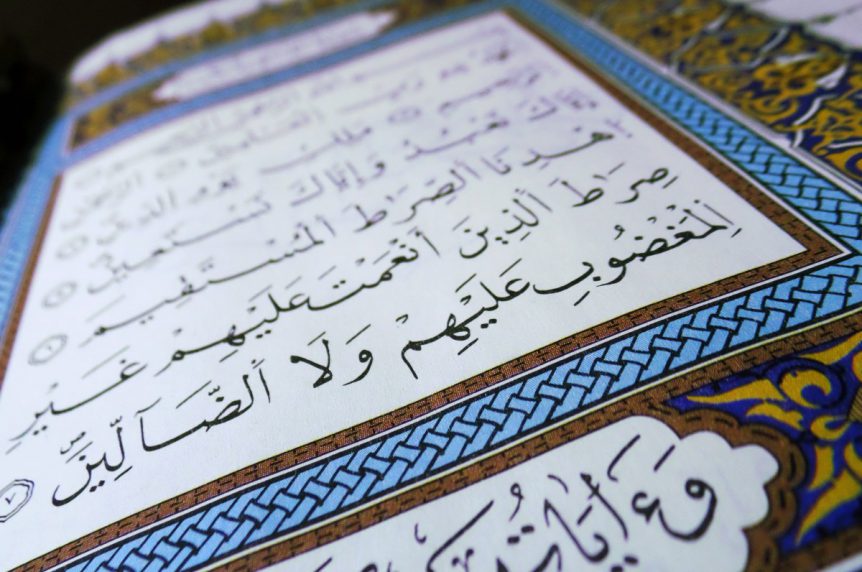
This page offers a complete Quran vocabulary list: every ayah in Arabic, paired with its English translation. The translation is by Abul Ala Maududi, and both the Arabic text and the English come from Tanzil.net, which hosts verified Quranic text alongside dozens of published translations. If you would like flash cards from a different Tanzil.net translation, let us know and we will happily create them.
The list is for learners who want to understand the Quran as they recite or listen, rather than depending on a printed translation beside the text. It also fits naturally into Modern Standard Arabic study: Quranic Arabic shares nearly all of its grammar with MSA and much of its core vocabulary, so hours spent on one keep paying into the other. Students memorizing surahs find the cards useful as well, since attaching a meaning to each ayah makes memorization easier to retain.
How to study Quran vocabulary effectively
Start with the short surahs. The surahs of the thirtieth juz are brief enough to work through in a single sitting, and many learners already know them by heart, so you are attaching meanings to sounds you can already recite. Their vocabulary also repeats throughout the rest of the Quran, and the early effort compounds.
Learn words in ayah context rather than in isolation. A bare word list tells you what a word can mean; an ayah shows what it does mean in a particular construction. Reviewing whole ayahs also trains you to parse real sentences instead of matching single words.
Use spaced repetition. The Anki deck below schedules each card to come back just before you would forget it. Ten to twenty minutes a day beats an occasional long session, because Quranic vocabulary is heavily repetitive: the high-frequency words keep returning until they stick.
Pair the cards with structured study. Flashcards build recognition, not grammar. Our Learn Quran page collects courses and word-for-word material aimed specifically at Quranic Arabic; working through one alongside daily review gives the vocabulary a framework to attach to.
You can use the vocabulary list in the following formats
The CSV holds each ayah with its translation, ready to import into any flashcard program or spreadsheet; the Anki deck is the same content already set up for spaced repetition.
Frequently asked questions
Is Quranic Arabic different from Modern Standard Arabic?
Not fundamentally. The Quran is written in Classical Arabic, and Modern Standard Arabic is its direct descendant, so the two share almost all of their grammar. The differences sit mostly in vocabulary and style: the Quran uses words and constructions that are rare in modern prose, while MSA has absorbed modern terms the Quran never needed. A learner with solid MSA can read the Quran with a dictionary and some patience.
How many unique words are in the Quran?
The Quran contains roughly 77,000 words in total. Counts of distinct words depend on how inflected forms are treated, but commonly cited figures fall around 14,000 to 15,000 unique word forms, drawn from a much smaller set of roots, often estimated at under 2,000. In practice, a few hundred high-frequency words account for most of the text, which is why steady review pays off quickly.
Can I learn Quranic Arabic without learning MSA?
Yes. Several well-known programs teach Quranic Arabic directly, and because the Quran's vocabulary is finite and heavily repeated, focused study takes you a long way without any modern Arabic. That said, most reference materials assume some MSA background, and grammar learned for one serves the other almost unchanged. If your only goal is understanding the Quran, start there.